
The tutorials at IFCS-EFTF 2025 will feature lecturers that are on-site in Querétaro and available to answer in-person questions. The tutorials will take place on Monday, May 12, 2025. 

All tutorials will be recorded and made available on the conference online platform shortly afterward. They can be viewed up to 30 days after the end of the conference, both by virtual attendees that registered for the tutorials, and in-person tutorial participants that want to refresh their memory or catch up on a lecture they missed.

No live streaming will be available this year to manage the cost of attendance. A dedicated discussion forum for each tutorial will provide an opportunity to contact the lecturers with questions.
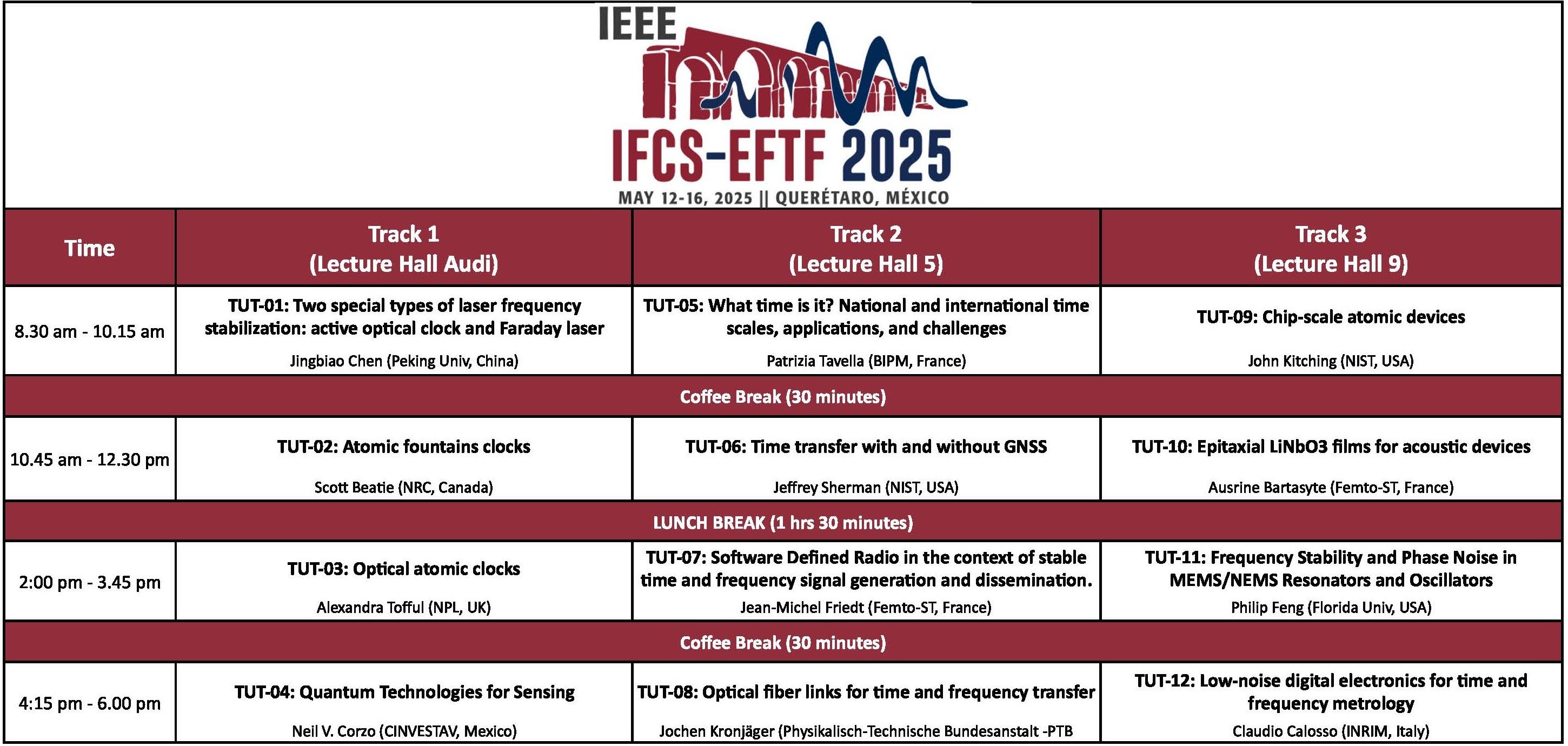
  • With the development of fundamental scientific research and advanced technology applications, laser frequency stabilization plays an increasingly important role in fields such as high-precision atomic clocks, gravitational wave detection, measurement of fundamental physical constants, and satellite navigation and positioning. In this tutorial, I will start from the demand for laser frequency stabilization in the field of atomic clock and introduce the commonly used methods of laser frequency stabilization, including the PDH technique, modulation transfer spectroscopy, and so on. Then I will focus on two special laser frequency stabilization methods: active optical clock and Faraday laser.

  • The 1967 redefinition of the SI second marked the beginning of the atomic age in frequency and time metrology, with caesium atoms becoming the standard for timekeeping. The development of laser cooling and atom trapping techniques led to the emergence of atomic fountain clocks as the most precise method to realize the SI second, a distinction they continue to hold today. This tutorial will provide an overview of the fundamental principles, challenges, and impact of atomic fountain clocks in precision time and frequency measurements. We will cover the key mechanisms behind their operation, including laser cooling, atom trapping, and Ramsey interrogation, and introduce concepts such as the Bloch sphere and Allan deviation. Additionally, we will explore the performance of fountain clocks in terms of stability and accuracy, examining sources of systematic frequency shifts like collisions, Zeeman shifts, black body radiation, and distributed cavity phase. Finally, the tutorial will highlight the critical role of fountain clocks in global timekeeping and their evolving function as we progress towards a potential redefinition of the SI second.

  • The exceptional accuracy of optical clocks is at the basis of the future redefinition of the SI second in terms of an optical frequency. Optical clocks are extraordinary metrological tools which also have applications beyond timekeeping. This tutorial will focus on the principles of optical clocks and their operation, and will give an overview of clock systems based on ions and neutral atoms, comparing their advantages and limitations. We will investigate the challenges of pushing the systematic and statistical uncertainty of optical clocks down to the 10-18 level and below. Next, we will look into the requirements for the optical redefinition of the second, and discuss the international efforts to carry out regular international clock comparison campaigns to satisfy these criteria. Finally, we will talk about some of the applications that make use of these state-of-the-art frequency metrology systems - from testing fundamental physics to relativistic geodesy.

  • The development of quantum mechanics, and the experimental implementation of its results, has revolutionized not only the way we understand our universe but also the approach to solving current technological problems. With the exquisite control of the interaction between light and matter, we have been able to develop new technologies based on the principles of quantum mechanics. These technologies have changed the way we process, store, and transmit information, but also they have changed the way we measure.

    In this tutorial, I will discuss implementing different quantum technologies and their applications to sensing.

  • Timekeeping in an important international need that calls for accurate and reliable coordination. The international standard time, the Coordinated Universal Time (UTC), is computed by the BIPM based on the contribution of about 450 atomic clocks kept in about 85 laboratories all over the world. Each laboratory contributes with its clocks and primary or secondary frequency standards, compared through GNSS or TWSTFT techniques. All these measures enter in UTC with a weight aiming to optimize the long term stability and accuracy of UTC.

  • Global Navigation Satellite Systems (GNSS), like the Global Positioning System (GPS), offer wide and inexpensive dissemination of time signals with nanosecond-level precision and accuracy. By far the most successful use of atomic clocks, GNSS supports billions of dollars of economic activity monthly in the United States alone. We will review the physical basis and common techniques of GNSS time dissemination and time transfer by using GNSS signals as a transfer standard. We highlight the few weaknesses of GNSS: low signal amplitude at Earth's surface admits accidental or purposeful interference; space-borne assets in general are vulnerable to space weather or other failures. What alternatives exist for nanosecond-level time transfer? We will review protocols and techniques for time transfer over computer networks, terrestrial broadcasts and point-to-point transmissions, other space-borne constellations, and direct fiber optic links.

  • Software Defined Radio (SDR) is a discrete time signal processing paradigm aimed at sampling the radiofrequency signal as early as possible and running all processing as software, benefiting from the stability, reconfigurability and tunability of digital algorithms over analog implementation. While commonly used for radiofrequency communication, SDR is perfectly suited for generating stable time and frequency signals and disseminating such signals over wireless links or fibers. In this tutorial, we start by introducing the basics of discrete time signal processing, demonstrating all concepts on the free, opensource software framework GNU Radio, illustrating such awkward concepts as imaginary voltage or negative frequency at the output of an IQ detector. We tackle the issue of IQ imbalance solved by complex mixing in the digital domain, before spreading the spectrum by introducing pseudo-random sequences to complement frequency transfer with time transfer. Following this introduction, we apply the acquired knowledge to process some real signal, including the acquisition step of GPS L1 C/A signals or VLF time transfer signals, to finally address how SDR was used to implement a Two Way Satellite Time and Frequency Transfer (TWSTFT) system. The participants might enjoy reproducing the experiments by bringing their own laptop installed with GNU Radio.

  • The very high stability and accuracy of state-of-the-art optical frequency standards require matching techniques for comparison and dissemination. For example, demonstrating agreement between different (possibly remote) optical frequency standards with an uncertainty below 5 × 10⁻¹⁸ is a key requirement towards the redefinition of the SI second. Optical fibre links have emerged as an excellent tool to meet this challenge.

  • Chip-scale atomic clocks, and associated technology such as chip-scale atomic magnetometers are now successful commercial products and research within this scientific field continues to be highly active. This tutorial will cover the design, fabrication and performance of chip-scale atomic devices including frequency stability, size, weight, power and manufacturability. The key physics elements that underlie these instruments will be discussed, as well as the most important application spaces in which these devices are used.  Current trends in the area of chip-scale atomic devices will be presented and some speculation for the future will be discussed.

  • The next generation of Radio-Frequency (RF) wide-band filters and frequency-agile filters is urgently needed for the development of 5G-6G infrastructures, networks, and communications. Currently, LiNbO₃ and LiTaO₃ single crystals and single-crystal films are key materials in electro-optics and RF acoustic filters. This motivates further development of acoustic wave devices based on high electromechanical coupling deposited LiNbO₃ thin films, tailored to the aforementioned RF applications. The growth of LiNbO₃ films has been considered particularly challenging due to the difficulties in controlling the film composition, orientation, and physical properties.

  • Resonant micro/nanoelectromechanical systems (MEMS/NEMS) have already emerged as transformative technologies, not only to continue advancing industry applications, but also to enable new tools and techniques in fundamental scientific explorations in both classical and quantum regimes.  In many of such technological applications and high-precision measurements, frequency stability and noise metrology are crucial, because the measurements of many important quantities of interest are often translated into measuring the frequencies of resonant MEMS/NEMS transducers, or their self-sustained feedback oscillators or clocks.  This tutorial will first provide an overview of the basic principles and key characteristics of resonant MEMS/NEMS.  It will then focus on fundamentals and techniques of quantifying frequency stability and phase noise in resonant MEMS/NEMS, the noise processes and their underlying mechanisms, as well as how they affect the measurements of frequency stability and phase noise.  Conventional methods and state-of-the-art experimental techniques will be reviewed and analyzed.  Case studies of various modern MEMS/NEMS resonators and feedback oscillators featuring different signal transduction mechanisms will also be discussed.  

  • This tutorial focuses on the role of electronics in time and frequency metrology. It shows why a proper design of the electronic apparatus is a key aspect of an application: a new experiment, instrument or facility. After a brief comparison of off-the-shelf commercial versus custom solutions, the tutorial will show how to develop a custom high-performance and flexible apparatus. High performance is provided by low noise components, while flexibility is guaranteed by digital devices, in particular by Field Programmable Gate Arrays (FPGAs). Practical examples among vapor cell clocks, coherent fiber links and timescale generation in realtime are then provided for clarifying the advantages of this approach.